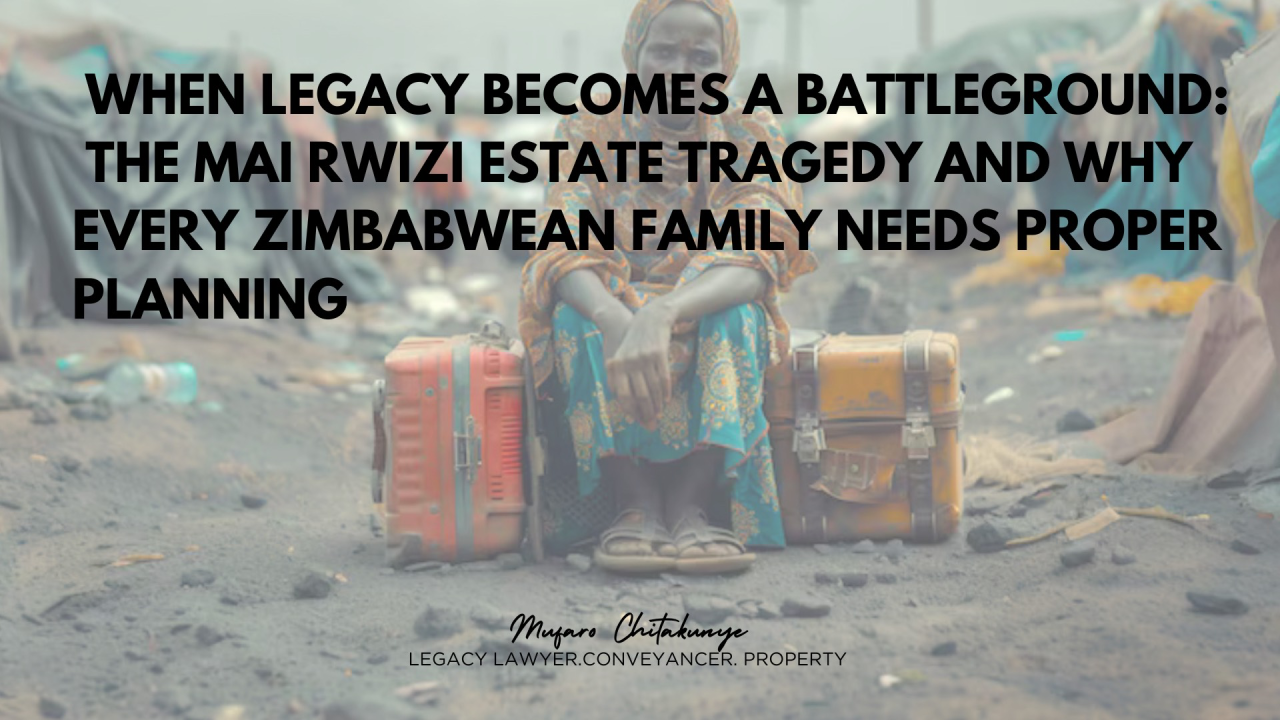

The heartbreaking story of the late Susan "Mai Rwizi" Chenjerai's estate has once again exposed the devastating consequences of inadequate family legacy planning in Zimbabwe. A woman who dedicated her life to uplifting others through entertainment, preaching, and philanthropy now rests while her disabled daughter Lydia faces eviction from the very home her mother helped build. This tragedy is not just a legal dispute it is a painful reminder that without proper estate planning tools, even the most loving families can descend into bitter conflict.
The Mai Rwizi Story: A Legacy Under Siege
Mai Rwizi's estate dispute embodies the complex challenges facing blended families in Zimbabwe. After meeting Lovemore Mubape in the early 1970s, Mai Rwizi brought six daughters from her previous marriage, while Mubape also had children of his own. Together, they built a home at Number 1 Barbra Tredgold Circle, Beatrice Cottages in Bare both investing in extending and refurbishing the property through decades of shared effort.
They married under the Customary Marriages Act, but the critical vulnerability in their arrangement has now been exposed: the property title deeds remained solely in Mubape's name. When Mai Rwizi passed away in July 2024, the wrangling reportedly began while her body still lay in the mortuary.
Today, Howard KamuchiraMubape's nephew whom Mai Rwizi raised after he lost his mother has been appointed executor of the estate and has successfully applied for the eviction of Lydia, Mai Rwizi's disabled daughter, along with two grandchildren. The irony is cruel: the woman who showed Kamuchira maternal love now sees her own vulnerable daughter forced from her home by the very person she nurtured.
The Legal Vulnerabilities That Created This Crisis
1. Property Ownership in Customary Marriages
Zimbabwe's default marital property regime is out of community of property, meaning each spouse retains ownership of assets in their individual names. In customary marriages, this creates particular vulnerability for women who contribute to property development but whose names do not appear on title deeds.
Mai Rwizi invested significantly in refurbishing and extending the Beatrice Cottages home. Yet under Zimbabwean law, her contributions carry limited legal weight because the property remained solely in her husband's name. This reality affects countless Zimbabwean women, particularly the estimated 70-80% who live in unregistered customary unions.
he Matrimonial Causes Act provides for equitable distribution of matrimonial property, but it applies primarily to registered marriages. Even where customary marriages are registered, proving contributions becomes a burden that surviving spouses must shoulder during their most vulnerable moments.
2. The Executor's Power and Fiduciary Duty
Once appointed, an executor wields considerable authority over the deceased estate. The executor's duties include identifying assets, paying debts, and distributing the estate according to law. Critically, the executor occupies a fiduciary position and must act in good faith.
However, when the executor has personal interests that conflict with those of other beneficiaries as appears to be the case with Kamuchira seeking to take control of the property for himself the potential for abuse is significant. Lydia's complaint that she was not served with court papers and only learned of eviction orders from the Messenger of Court suggests potential procedural irregularities that warrant scrutiny.
3. The Vulnerability of Disabled Dependents
Perhaps the most disturbing aspect of this case is the eviction of Lydia, a disabled daughter who requires ongoing support and protection. Zimbabwean law recognizes the vulnerability of certain beneficiaries. The Administration of Estates Act requires that money devolving upon "vulnerable beneficiaries such as minors, mentally disordered or defective persons" be paid to the Master of the High Court for protection.
Yet when estate planning tools like wills and trusts are absent, disabled children face particular jeopardy. Without explicit provisions ensuring their lifetime care and housing security, they become dependent on the goodwill of executors and other family members—goodwill that, as this case demonstrates, cannot always be relied upon.
What Proper Legacy Planning Could Have Prevented
Family Trusts: The Superior Estate Planning Tool
A family trust would have fundamentally altered this outcome. Had Mai Rwizi and Mubape established a family trust during their lifetime, they could have:
Protected the family home for all children. Trust property is managed by trustees for the benefit of specified beneficiaries. The trust deed could have explicitly named all children both Mai Rwizi's daughters and Mubape's children as beneficiaries, ensuring the home would serve multiple generations rather than enriching a single individual.
Provided for Lydia's special needs. A properly structured trust could include specific provisions for Lydia's lifetime care, ensuring she would never face homelessness due to her disability. Special needs trusts are designed precisely to protect vulnerable beneficiaries while maintaining their dignity and security.
Prevented inheritance wrangles. Property registered in a trust is not subject to distribution upon death of the founders. The property remains protected, managed by trustees according to the trust deed's provisions. This continuity eliminates the chaos that often follows death when families must navigate unfamiliar legal processes while grieving.
Protected assets from individual creditors. Trust assets belong to the trust entity, not to individual trustees or beneficiaries. This provides protection that individual ownership cannot match.
Wills with Life Interest Provisions
Even without a trust, a properly drafted will could have protected Mai Rwizi's interests. A life interest trust within a will allows a surviving spouse or partner to benefit from property during their lifetime, with the property ultimately passing to specified beneficiaries upon that person's death.
Had Mubape's will granted Mai Rwizi a life interest in the Beatrice Cottages property, she would have had security during her lifetime. The will could then have specified that upon her death, the property would pass to all the children from both families, ensuring equitable treatment.
Such provisions are particularly valuable for blended families, preventing the common scenario where a surviving spouse inherits everything and then leaves it solely to their biological children, disinheriting their deceased partner's children.
The Family Constitution: Preventing Conflict Before It Starts
Beyond legal documents, this family desperately needed a family constitution a comprehensive governance framework that would have articulated shared values, decision making processes, and provisions for vulnerable family members.
A family constitution is not merely a legal document; it is a process of family dialogue that creates alignment around fundamental questions:
- How should family property be managed and passed to the next generation?
- What provisions will be made for vulnerable family members?
- How will disputes be resolved?
- What values and principles should guide family decisions?
For blended families like Mai Rwizi's, where multiple children from different relationships must navigate complex emotional terrain, a family constitution provides clarity and prevents the "he said, she said" conflicts that emerge when intentions were never properly documented or communicated.
The constitution could have explicitly recognized Mai Rwizi's contributions to the family home, affirmed the equal standing of all children regardless of biological lineage, and established clear procedures for caring for Lydia's special needs.
The choice is yours: plan your legacy, or leave it to chance Mai Rwizi's daughter deserves better. So does your family.
Mufaro Chitakunye is a legal practitioner and educator at The Law & Legacy Hub, dedicated to making law accessible to every Zimbabwean family. For estate planning guidance, contact The Law & Legacy Hub at +263 772 658 355 or visit legacylawhub.com.